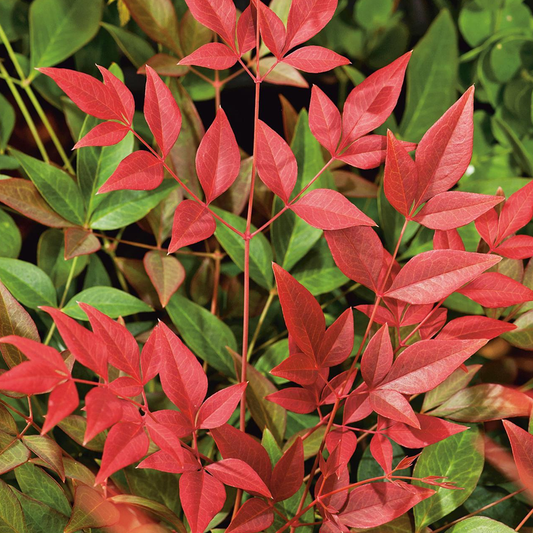
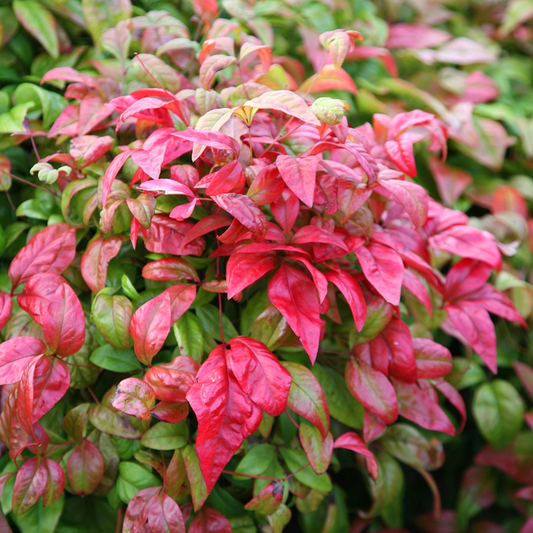
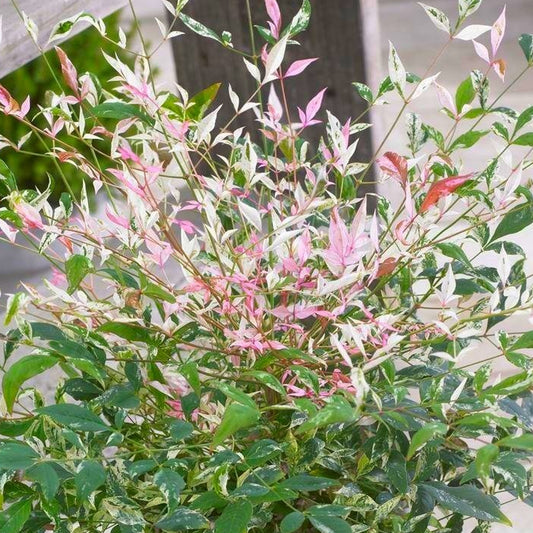
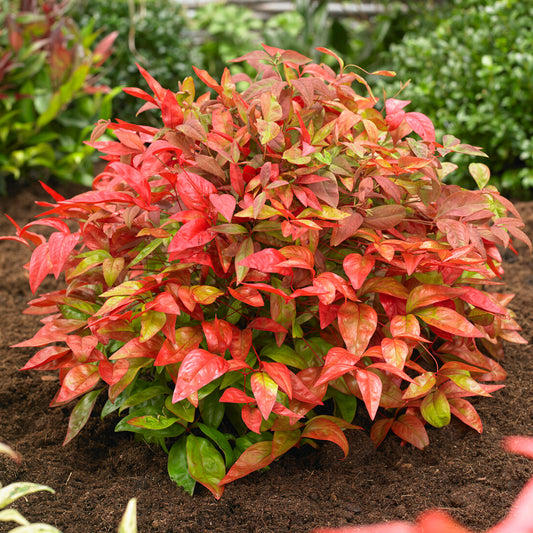
Light up your garden all year round with this evergreen, low-maintenance shrub. Nandina’s colour-changing foliage varies from fiery red to lime green or pretty pink, depending on the variety and time of year.
Nandina (heavenly bamboo) is an evergreen or semi-evergreen shrub, grown mainly for its colour-changing foliage. Despite its common name, it’s not a true bamboo, and modern cultivars aren’t as invasive as some reports would suggest. Nandina domestica is native to eastern Asia, and people commonly plant it on either side of doors in Japan to ward off bad luck. It’s a brilliant shrub for winter colour and a great option for low-maintenance gardens.
Nandina is included in the HTA Guide to Potentially Harmful Plants. It’s a category C plant, so it’s considered less harmful than common garden plants like foxgloves and lupins, but you may want to avoid planting it within reach of pets or young children who enjoy foraging. Nandina berries are toxic to birds in large quantities, though this is only likely to be an issue if there’s a lack of other food sources.
Where to plant nandina

Nandina grows well in full sun or partial shade, though planting red-leaved cultivars in full sun will give you the most vibrant colours. Choose a sheltered spot if your garden is in an exposed location or you get icy winds. Well-drained soil is best, and nandina prefers slightly acidic soils. If you have alkaline soil, you can add sulphur to the soil to lower the pH or grow Nandina in a pot.
Nandina domestica grows up to two metres, but many of its cultivars are more compact, maxing out at under a metre. These varieties, which include ‘Fire Power’ and ‘Blush Pink’, grow well in pots and work well at the front of borders, where they can soften the line between hard landscaping and flower beds.
When to plant nandina
Spring or autumn is the ideal time to plant nandina, when the soil is moist and warm and you don’t have to worry about extreme temperatures. However, with a little extra care, you can plant container-grown nandina at any time of year.
How to plant nandina

Before planting nandina, dig some well-rotted compost or other organic matter into the soil. If you have heavy soil, you may also want to add a couple of handfuls of grit to help with drainage. Dig a large hole that’s deep enough so that the top of the root ball is level with the surface. Backfill with soil and water well.
When planting Nandina domestica in pots, use a mix of multi-purpose and ericaceous compost, with some grit for drainage. Nandina grows deep roots, so a taller pot will suit it better than a low, wide planter. Nandina is slow-growing, but you want to give it enough room to allow for a couple of years’ growth.
Caring for Nandina domestica plants

Nandina is delightfully low-maintenance. New shrubs will need regular watering during the first growing season to help them establish strong roots, but after that they need little attention. Nandina is hardy, and most varieties can withstand temperatures down to -15°C without winter protection.
If you’re growing nandina in a pot, you’ll need to water it during dry periods, though don’t go overboard, as it won’t appreciate being waterlogged.
Nandina needs little, if any, pruning. Remove any damaged, dead or diseased branches and thin out any crowded shoots in mid-spring, after the risk of frost has passed.
How to propagate nandina
The best method for propagating nandina is to take semi-ripe cuttings in late summer or early autumn. Select a stem with fresh growth and a woody base and cut just above a leaf node, where the stem is pliable but not soft. Trim the cutting to around 15 cm and remove the bottom leaves and, if necessary, the soft top. Dip the cuttings in rooting powder and insert them into a pot filled with cutting compost. Water well and keep the soil moist while the cuttings are rooting.
How to grow nandina from seed
You can grow nandina from seed, though germination can be erratic, and it will take time for the seedlings to grow large enough to be planted outside. Sow seeds 3 mm deep in seed compost, place in a polythene bag and store in a cold place (e.g. a fridge) for 12 weeks before moving to a warm spot to encourage germination. If you’re collecting your own seeds, you can either remove them from the berries or just plant the berries directly into a potting mix. Have patience – it may take up to a year for your seedlings to appear!
Common problems
Nandina is resilient to pests and disease, though rarely, plants may be affected by viruses or honey fungus.
Our favourite varieties of nandina
Nandina ‘Obsessed’ sports colour-changing foliage that starts out red, before turning green in summer, then back to red in autumn. Plant it in full sun to get the richest colours.
Nandina ‘Fire Power’ is one of the best shrubs for winter colour. Its spring leaves are bright green, but towards the end of the summer, they turn a fiery red and maintain this colour through the autumn and winter.
Nandina ‘Lemon and Lime’ is a lovely evergreen nandina with yellow-green leaves that darken in the shade, giving the plant a sun-drenched look.
Nandina ‘Twilight’ has unique colour-changing leaves that start out flamingo-pink before maturing to green, splashed with white. Small white flowers appear in summer.
FAQ
When is the best time to plant nandina?
It’s best to plant nandina in spring or autumn, when the soil is warm and moist. You can plant pot-grown nandina at any time of year, but they may need additional watering in summer. Try to avoid planting during periods of frost or very cold weather.
Is nandina toxic to cats?
Yes, nandina can be toxic to cats and dogs, particularly if they ingest the berries, which contain concentrated cyanogenic glycosides. If you suspect your pet has eaten nandina, contact your vet immediately for advice. Some varieties of nandina, such as ‘Lemon and Lime’, don’t produce berries.
Are nandina berries toxic to humans?
Nandina berries can be toxic to humans if eaten in large quantities. To be safe, it’s best to plant nandina out of the reach of young children. You could also choose a variety that is less likely to produce berries, such as Nandina ‘Lemon and Lime’.