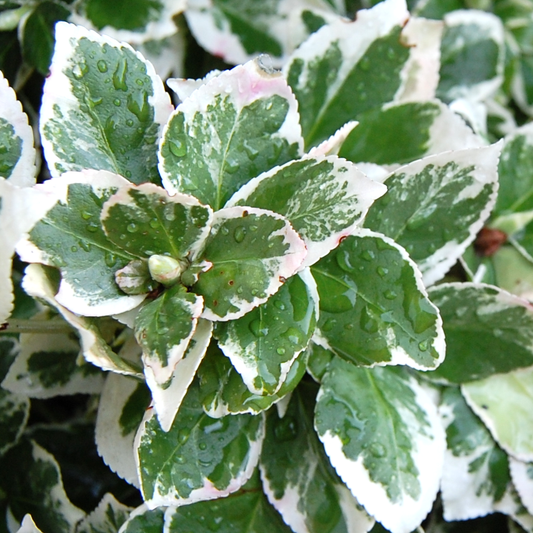
Euonymus earns its place in the garden as a tough, low maintenance shrub with plenty of uses. Choose Euonymus alatus for fiery autumn colour or one of the many evergreen euonymus cultivars for glossy green or variegated foliage.
Euonymus come in a wide range of shapes and sizes. Evergreen euonymus are grown for their year-round foliage, which is often variegated. You can use different varieties as groundcover, low climbing plants or in borders. Euonymus hedging plants are a great alternative to box if you want a low, slow-growing hedge. Deciduous varieties offer spectacular autumn colour, as well as flowers and berries in spring and summer. You can grow deciduous euonymus as shrubs, specimen plants or small trees, either on their own or as part of an informal mixed hedge.
The most popular species of euonymus in the UK are Euonymus japonicus (Japanese spindle) and Euonymus fortunei (winter creeper), which are evergreen euonymus, and Euonymus alatus (winged spindle) and Euonymus europaeus (spindle), which are deciduous varieties.
Where to plant euonymus

Most euonymus varieties prefer full sun or light shade. Cultivars of Euonymus fortunei such as Euonymus ‘Emerald Gaiety’ and ‘Emerald ‘n’ Gold’ are more shade tolerant, though colours will be brighter in the sun. Euonymus are resilient plants and can cope with varying aspects and wind conditions. Euonymus japonicus ‘Green Spire’ and ‘Bravo’ are good choices for coastal locations as they can deal with the salt and exposure.
You can plant euonymus in any moist, well-drained soil, including clay or chalk soils. Euonymus europaeus and Euonymus alatus are particularly good choices for colourful shrubs in chalky areas.
When to plant euonymus
Autumn and spring are the ideal time to plant euonymus shrubs and trees, but you can plant them at any time of the year, as long as the ground isn’t frozen. If you’re planting an euonymus bush in summer, make sure you water it well, especially if the weather is hot and dry.
How to plant euonymus

Water your plant well before planting. Euonymus tolerates most soil types, though it’s worth digging some compost or other organic matter into the soil if it’s very poor or heavy. Dig a hole twice the size of the root ball and position your plant in the hole. Backfill with soil so the plant is at the same depth as it was in its original pot.
You can grow compact varieties, such as Euonymus ‘Bravo’ and Euonymus 'Paloma Blanca' in containers. Fill a large container, at least 30 cm deep and wide, with a soil-based compost and plant your euonymus at the same depth as the original pot.
Caring for a euonymus
Water euonymus plants well during dry spells for the first two years after planting. This helps encourage the roots to grow down and out into the surrounding soil. You don’t need to feed plants once established, but add a thick layer of mulch in early spring.
Euonymus grown in pots will need regular watering to prevent the compost from drying out. You may also need to apply a liquid fertiliser a couple of times during the growing season. You shouldn’t need to repot your euonymus every year, but keep an eye on your plant for signs that it’s outgrowing its pot and, if necessary, move it into a larger container in spring.
Training and pruning euonymus

You can train certain cultivars to grow up walls and fences, though they need a bit of support at the beginning. Upright varieties of Euonymus fortunei like Euonymus ‘Emerald ‘n’ Gold’ and ‘Emerald Gaiety’ typically work best as climbing plants. Use soft twine to tie the longest upright stems to a trellis as the plant grows. If you don’t want to put a trellis up, you can also use horizontal wires. Climbing euonymus varieties produce aerial roots – furry tendrils that emerge from different points on the stems and cling to support structures. Once these are sufficiently established, you can remove the twine.
Deciduous euonymus only need a light pruning in late winter or early spring to remove any dead or damaged stems. Evergreen euonymus, including euonymus hedging plants and climbing euonymus, should be pruned in mid-late spring, unless this interferes with nesting birds. If you spot non-variegated green shoots on cultivars with variegated leaves, remove these immediately to prevent them from taking over.
How to propagate euonymus
You can propagate evergreen euonymus by taking semi-ripe cuttings in mid-late summer. Prepare your cuttings and add them to a pot of cuttings compost. Store in a greenhouse or cover with a plastic bag to keep the compost moist. The cuttings should be ready to plant out the following spring.
Deciduous euonymus are best propagated using hardwood cuttings taken during the plant’s dormant period, though Euonymus alatus can grow well from softwood cuttings taken in spring.
Euonymus problems
Euonymus are tough plants, but they occasionally struggle with pests or disease.
Euonymus scale infestation is the most common serious problem you may encounter. These sap-sucking insects are common in England, particularly in southern areas. Small numbers of the insects shouldn’t cause much harm to healthy plants, but if a plant is badly affected, it may lose most of its leaves and suffer dieback. The kidney spot ladybird is a natural predator, along with parasitoid wasps and some birds.
Evergreen euonymus varieties are prone to shedding their leaves during prolonged dry spells. You can avoid this by watering them deeply weekly.
Vine weevils may feed on evergreen euonymus leaves, though they rarely cause significant harm to established plants. If they’re damaging potted plants, it may be worth repotting the plant in fresh compost.
Honey fungus and phytophthora root rot may affect euonymus bushes. Destroy infected plants and plant alternative species that are resistant to the fungus in their place.
Our favourite varieties of euonymus
Euonymus ‘Green Spire’ is a dense, upright variety with small green leaves. It’s a popular evergreen euonymus for hedging as it’s hardy and easily shaped – a great alternative to box.
Euonymus alatus lives up to its common name of the burning bush in autumn, when its leaves burn crimson. Give it plenty of space to grow in the sun as a specimen shrub or part of a mixed border.
Euonymus fortunei ‘Emerald ‘n’ Gold’ is a popular evergreen variety with variegated golden-green leaves. You can grow it as a bushy shrub, a hedge or a climbing plant, and it grows well in shade, though the leaves may lose some of their golden glow.
Euonymus ‘Himalaya’ is an Euonymus japonicus plant with striking white leaves that turn dark green as they mature. It works well grown as a hedge or planted in narrow borders around the edge of lawns.
Euonymus ‘Harlequin’ has beautiful cream and green variegated leaves that flush pink around the edges in autumn. It’s a low-growing plant that looks good in pots or as ground cover in borders.
FAQ
When should I prune euonymus?
Prune euonymus hedges and other evergreen varieties in mid-late spring. If birds are nesting, delay pruning until late summer. Deciduous euonymus like Euonymus alatus don’t need much pruning, but you can tidy them up and remove any damaged or diseased stems in late winter or early spring.
Is euonymus poisonous to dogs?
Yes, euonymus plants contain alkaloids that can be harmful to humans and pets if eaten. It can cause gastrointestinal symptoms like stomach pain, vomiting and diarrhoea, though it’s only likely to be a serious problem if your pet has consumed large quantities. Contact your vet immediately if you think your dog has eaten this plant.
Does euonymus grow in shade?
Most euonymus plants will grow in partial shade, though it may affect leaf colour and growth. The best euonymus to grow in shade are Euonymus fortunei varieties like ‘Emerald Gaiety’ and ‘Emerald ‘n’ Gold’. Grow deciduous varieties in full sun to get the brightest autumn colours.
Is euonymus evergreen?
You can buy both evergreen and deciduous varieties of euonymus. Cultivars of Euonymus japonicus and Euonymus fortunei are evergreen or semi-evergreen, whereas Euonymus alatus and Euonymus europaeus lose their leaves in winter. Deciduous euonymus give vibrant colour in autumn, whereas evergreen euonymus provide more subtle year-round colour.
How big does euonymus grow?
Euonymus plants come in various shapes and sizes. Low-growing varieties, such as Euonymus ‘Harlequin’ grow to around 60 cm, but taller varieties can grow up to 4 m. You can also grow deciduous euonymus as a bonsai tree.