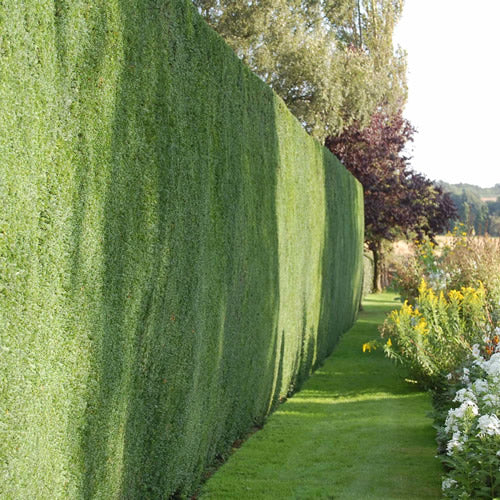
Hedges add colour and structure to a garden, as well providing food and a home for wildlife. Planting a hedge doesn’t have to be intimidating – our guide will help you choose the right type of hedge and teach you how to plant and care for it.
Planting a hedge in your garden has so many benefits, both for you and your local wildlife. While growing a hedge requires patience, the effort is worth it – and if you want an instant hedge, there are options for that, too. Whether you’d like a fast-growing evergreen hedge for privacy, a wildlife-friendly native hedge of flowering trees or to create a border for a flower bed in a formal garden, we’ll help you choose the right hedging plants and give you the information you need to help them thrive.
We have a wide range of bare root hedging available in the winter months, and our potted hedging plants are available year round.
Choosing hedging plants

The right hedge for your garden will depend on a wide range of factors, including space, environmental conditions and the purpose of the hedge. Here’s a quick summary of what you need to consider to help you decide.
Soil conditions and aspect
You can buy hedge plants to suit almost any type of soil and for sun or shade. Plants are always happiest in their ideal growing conditions, so rather than trying to change your soil to suit the hedge, choose the right hedging plants for the soil.
If you have a neutral, well-drained soil, you can take your pick of plants. Chalky soils are tricky, but Osmanthus burkwoodii and Berberis darwinii will both tolerate this soil type. You have more options with clay soils, including Pyracantha, berberis, Cotoneaster horizontalis, laurels and Viburnum opulus. Hedging plants that like waterlogged soil include Salix (willow) and alder.
Most hedges will thrive in full sun, and many will grow well in partial shade. If you want to grow a hedge in deep shade, consider yew, Euonymus fortunei, holly, cherry laurel or Portuguese laurel.
Style of hedge

A hedge is a core structural element of a garden, so you want to make sure it complements your wider garden design and style. In addition, you may grow a hedge for a specific purpose, such as shielding an ugly view, adding colour or to create habitat for wildlife. Here are some examples of types of hedges that suit different purposes:
-
Privacy hedges: tall, fast-growing shrubs and trees create a screen between your garden and the surrounding area, giving it a secluded feel. Fast-growing hedges are also useful to hide eyesores, such as garages, sheds or surrounding structures. Examples include cherry laurel, leylandii, western red cedar, and beech.
-
Formal tall hedges: formal hedges typically have smaller leaves or needles to give a uniform effect when trimmed. Once grown, the plants blend together into one long structure. Examples include privet, yew, Portuguese laurel and hornbeam.
-
Formal low-growing hedges and topiary: clipped, low-growing hedges create a neat border around flower beds or small gardens. Choose slow-growing plants that you can easily trim to create a neat shape. Examples include box and yew.
-
Informal hedges: create a relaxed edge to beds, borders and garden boundaries with low-maintenance informal hedging plants – great for cottage gardens and other naturalistic planting schemes. Examples include lavender, cotoneaster, guelder rose (Viburnum opulus), hawthorn and bird cherry.
-
Flowering hedges: flowering hedge plants blend in with your beds and borders, creating a softer boundary. The flowers and berries add interest and support local bees, birds and other wildlife. Examples include hawthorn, blackthorn, firethorn and Burkwood osmanthus – or opt for a flowering hedge mix.
-
Colourful hedges: some hedge plants are grown for their dramatic foliage, which can brighten your garden at different times of the year. Examples include copper beech, dogwood, Photinia ‘Red Robin’ and Japanese barberry.
-
Security hedges: spiky hedge plants deter unwanted intruders, whether that’s thieves or foxes. Examples include berberis, Pyracantha (firethorn) and blackthorn.
Deciduous vs evergreen garden hedges
Both deciduous and evergreen hedges have pros and cons, and there are various factors to consider when choosing a hedge for your garden.
Evergreen hedges hold their leaves year round. This makes them popular for privacy hedges, but they’re also a good choice if you want year-round colour, for example in a small front garden. Although most evergreen plants have green foliage, a few varieties, such as Photinia ‘Red Robin’ offer brighter colours. Evergreen hedges typically require more pruning and maintenance than deciduous hedges.
Deciduous hedges shed their leaves in autumn and grow new leaves in spring. This can reduce privacy during the winter months, but the hedge will also block out less light at a time when the sun is lower in the sky. This tradeoff may be worthwhile for hedges planted close to windows. Deciduous hedges often have more colour and interest throughout the spring, summer and autumn. They also tend to offer more value to wildlife than evergreen hedges.
Size and growth rate
Hedges win over fences hands down when it comes to wind protection, visual appeal and benefits to wildlife, but in small gardens, you may be concerned about how much space a hedge takes up. With regular pruning, you can keep many hedges slim. Privet, yew, Photinia and Pyracantha can all be pruned hard, making them some of the best narrow hedge plants in the UK.
As well as overall size, it’s also important to consider the growth rate of the hedge plants you choose. Fast-growing plants are brilliant when you want to establish a hedge fast, but those plants will keep on growing! Certain evergreen varieties don’t regrow if you cut back into old wood, so if you don’t keep on top of the pruning, you could be left with an ugly mess. Deciduous trees tend to be more tolerant of hard pruning and lower maintenance, but they’re slower growing.
Types of hedging plants

You can buy three types of hedge plants, though they’re not all available year round:
-
Bare root hedging plants are available between November and March, when deciduous plants are dormant. These are typically younger plants and are the best option for cheap hedge plants. Hedge whips are bare root, unbranched trees that are usually only a year old. You may wonder how a full hedge can grow from what appears to be a bunch of sticks, but this is how most farmers and large landowners plant their hedgerows.
-
Root ball hedging plants are usually more mature. The plants are scooped out of the ground and the roots wrapped with hessian to keep soil around the root ball. Evergreen hedge plants are often sold as root ball hedging. Root ball hedges are available from around October to April.
-
Pot-grown hedging can vary from small hedge plants in 9 cm pots to large specimens that are already a metre or two tall. Pot-grown hedge plants are more expensive, as it costs more to grow and care for these plants, but they do have a couple of advantages. The plants have an established root system, which hasn’t been disturbed by being dug out of the ground, so you get a high success rate. You can also plant potted hedging at any time of year, which is useful if you’re developing your garden in spring or summer and want instant hedging.
When to plant hedges
The best time to plant your hedge depends on how you’re buying your hedge plants and whether you want an evergreen or deciduous hedge.
You can plant our potted hedging plants at any time of year, and we have a full range of both evergreen and deciduous varieties. This is likely your only option for hedges planted in spring and summer and it’s the best choice if you want to plant a mature hedge. Avoid planting during very cold or very hot, dry periods. The ideal time to plant is spring or autumn, when the soil is moist and warm.
Evergreen root ball hedges are best planted in autumn – ideally late October as soon as the plants become available. This gives the plants time to settle in before the cold weather really sets in. Spring is the next best time to plant, once the soil has started to warm up.
Deciduous bare root hedging must be planted between November and March when the hedging plants are dormant. November is ideal, but avoid trying to plant in frozen ground. Bear in mind that hedging suppliers may run out of bare root hedging before the end of the season.
Hedge planting spacing
The number of hedge plants you need will depend on the length of hedge, whether you’re using bare root or pot-grown plants and the type of hedge. Spacing plants correctly ensures that each plant can access the sunlight and nutrients it needs and gives you a structured, good-looking hedge without gaps or bare patches. The density of your hedge will also depend on whether you’re planting a single-row hedge or a double-row hedge.
As a very rough guide, you’re likely to plant 5–7 bare root hedge plants per metre (depending on the size of the plant) or 2–4 pot-grown plants per metre. Space mature hedging plants further apart than young plants. You can use the hedge plant calculator on our product pages to calculate how many hedge plants you need to buy.
How to plant a hedge
How to plant a bare root hedge
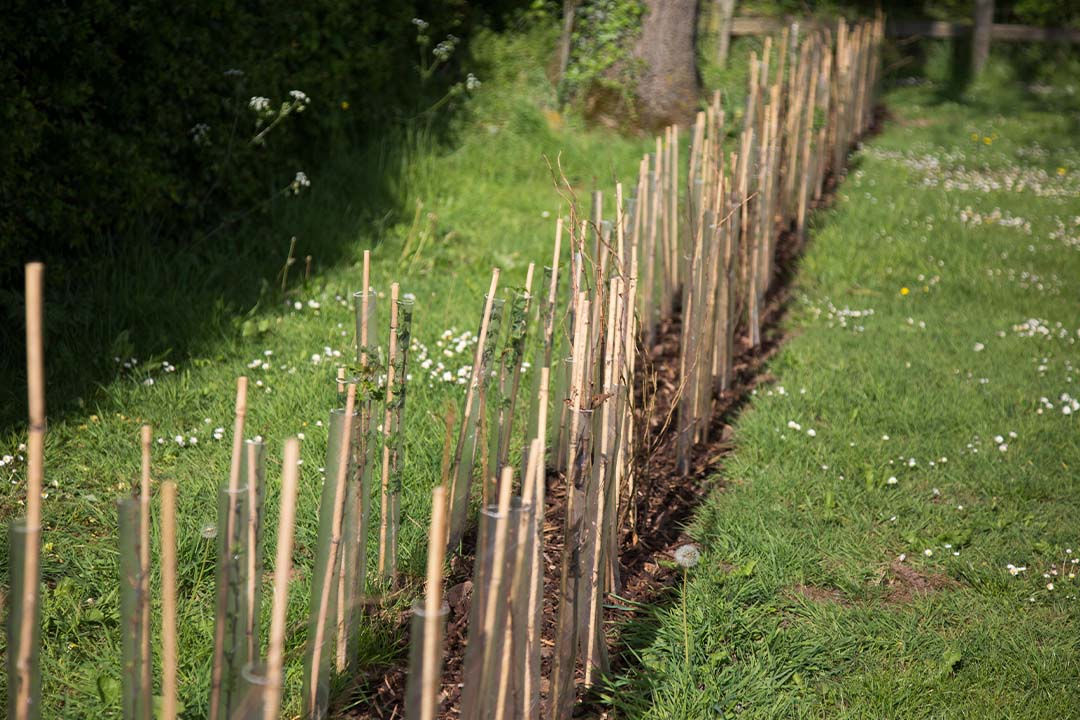
Plant bare root hedging as soon as possible after it arrives, so the roots don’t dry out. If you can’t plant them immediately, heel the plants into the ground temporarily. Heeling in is when you dig a trench or hole and lay the plants in at an angle before covering them with soil. This helps keep the roots moist, and laying them down protects them from wind damage.
While you’re preparing your planting site, soak your bare root plants in water. Remove any weeds and dig over the area you’re planting in to loosen the soil. Dig a trench that’s deep and wide enough to comfortably fit your plants. Look for a soil mark on your hedging plants to help determine how deep you need to plant them. If your hedge is going to form a boundary, you’ll need to dig your trench two or three feet in from the boundary line to leave growing room for your hedge.
If you’re planting a long hedge, it’s worth using a length of string attached to a cane at each end of the trench to help you keep a straight line. You may also find it helpful to cut a length of cane (or a stick!) to the correct spacing distance – you can use this to measure the distance between plants and ensure they’re spaced evenly.
We recommend dipping your bare root plants in rootgrow gel before planting. It’s endorsed by the RHS and contains mycorrhizal fungi that help plants develop strong root systems.
Position your plants in the trench, then backfill with the soil you dug out. Make sure this covers each plant to the correct depth as indicated by the soil mark on the stem. If your soil is very sandy or has a tendency to get waterlogged, mix some compost in with the soil when backfilling. Once you’ve filled the trench, gently firm the soil and water each plant in well. Add a mulch of bark chips or other organic matter to help prevent weeds.
How to plant a potted hedge

To plant a hedge using pot-grown plants, prepare the ground in the same way as for bare root hedging. Give the potted plants a good soak a few hours before planting.
Dig a trench twice the width of the pot and deep enough that the top of the root ball is level or slightly below the top of the trench. If you don’t have space to prepare the ground around the trench, use a fork to loosen the soil at the sides and base of the trench to help the roots spread out.
Sprinkle some rootgrow mycorrhizal fungi granules in the bottom of the trench to encourage root growth. Remove your hedge plants from their pots and place them in the trench, making sure they’re evenly spaced. Backfill using the dugout soil or a mix of soil and compost. Firm the soil around the plants gently and water well. Add a thick layer of mulch, but make sure the mulch doesn’t touch the stems of the plants.
How to care for a hedge
Newly planted hedges need watering for two years, particularly during the spring and throughout dry summers. It’s best to water deeply twice a week rather than applying a smaller amount of water daily.
If your hedge is in an exposed location, you may need to protect bare root hedging plants from the elements. Windbreak netting, held in place with wooden stakes, is a cost-effective way to protect your hedge plants from harsh winds. You may also want to use netting or chicken wire to protect young plants from rabbits and deer.
Weeds can compete with hedge plants for nutrients and water, so it’s important to keep the area around your hedge weed-free. Mulching with organic matter from your garden or bark chips can help with this.
Apply a general-purpose fertiliser, such as our Growmore fertiliser, around the plants at surface level in spring.
When to prune hedges

Formative pruning helps encourage new growth to create a full, bushy hedge. Carry out this type of pruning annually for up to five years after planting your hedge. Prune deciduous trees in winter. Cut back shoots extending up or outwards by a third, making each cut just above a bud. Leave the central leading shoot unpruned on evergreen hedge plants (pruning at this stage will halt upward growth), but trim side shoots as required in summer for conifers and spring for other plants.
Once your hedge is at the right height and width, you’ll need to prune it to maintain its shape and prevent it from getting overgrown. Read our detailed post on trimming hedges for a step-by-step guide.
The frequency and timing of pruning depends on the species of hedge and whether it’s a formal or informal hedge. Informal hedges only need pruning once a year – this is best done after flowering or in late summer or early autumn to avoid nesting birds. Some formal hedges, such as beech, hornbeam and holly, only need pruning once a year, but most require pruning twice or even three times during the growing season.
Problems with hedges
If your hedge plants struggle to get established, you can end up with unsightly gaps in your hedge. To avoid this, follow the guidance above, particularly around watering and weeding in the first few years, and provide protection from the wind or animals if required. Bare root trees are more likely to fail, but using rootgrow gel can make a big difference in helping them establish.
FAQ
How do you plant a hedge?
First, dig over the ground around where you want to plant the hedge. Soak your bare root hedge plants or potted plants while you’re digging a trench. The trench should be double the width of the root ball for potted plants and deep enough so the soil mark on the plant is level with the ground. Space the hedge plants evenly along the trench and backfill with soil. Firm in and water well. To help the hedge establish strong roots, use rootgrow granules or gel.
When should you plant a hedge?
The best time to plant a bare root hedge is between November and March. Evergreen root ball hedging is best planted a little earlier, around the end of October, or later, at the start of spring when the soil is slightly warmer. You can plant pot-grown hedging at any time of year, though you’ll need to keep on top of watering it if you plant it in a dry summer.
How close to a boundary can I plant a hedge?
It’s best to plant a hedge about three feet from a boundary. This gives the hedge space to grow without encroaching on your neighbour’s land. It also gives plenty of space for the hedge to develop roots if you’re planting up against a wall or fence.
What is hedge laying?
Hedge laying is the traditional practice of partially cutting and bending the stems of hedge plants so they lay at an angle. The stems and branches are woven together to secure the hedge. Hedge laying creates a dense hedge that’s a haven for wildlife, as well as keeping the hedge in shape. Laying a hedge requires skill and knowledge, so if you’re interested in learning how to do it, it’s best to find a local course.