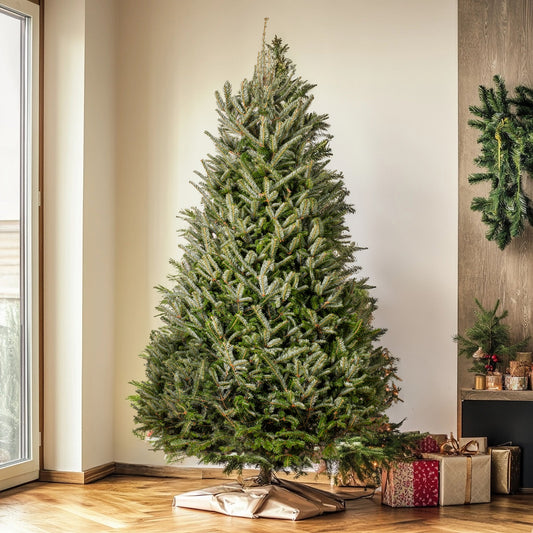
It’s beginning to feel a lot like Christmas… Which means it’s time to order your Christmas tree. Pile the decorations on a Nordmann fir or breathe in the pine scent of a Norway spruce. Whatever your priority is this Christmas, we’ve got the perfect real Christmas tree for you.
Nothing beats the magic of a real Christmas tree, but with so many varieties to choose from, deciding which is the best Christmas tree for your home can be tricky. In this guide, I’ll run through the pros and cons of the most popular types of Christmas trees to take the guesswork out of your decision.
Life can get busy and stressful at this time of year. If you’re struggling to find time to go out and buy a tree or you don’t have a car, buy your Christmas tree online. You don’t have to worry about traipsing round muddy fields or scratching your paintwork as you try to strap a heavy tree to your car roof. We’ll select one of our premium quality UK-grown trees and ship it to your door, with free delivery on orders over £50. It’s the relaxing, no-hassle approach to Christmas tree shopping!
What types of Christmas trees are available in the UK?
Nordmann Fir

Nordmann firs are the most popular type of Christmas tree sold in the UK. They have a lovely symmetrical shape, and the spaced, layered branches give you room to hang baubles, ornaments and the collection of wonky home-made decorations your kids bring home from school each year.
Nordmann firs are one of the best Christmas trees for needle retention, and the needles are soft, meaning you don’t have to worry about getting spiked when decorating your tree. This also makes them an excellent choice for families with young children or pets.
Choose a Nordmann fir if you:
-
don’t want to hoover or sweep up needles – Nordmann needles are slow to drop.
-
have lots of decorations to hang.
-
want to get your tree up early – cut trees will look good for up to five weeks.
-
suffer from allergies – the needles have a waxy coating that means they’re less likely to trigger allergies.
Order your pot grown Nordmann fir or fresh cut Nordmann fir today.
Norway Spruce

Norway spruces have the classic conical shape we associate with traditional Christmas trees. It’s the UK’s original Christmas tree and the most popular variety for more than a hundred years. Norway spruces are more prone to shedding needles than other varieties, but keeping your tree well watered helps minimise needle loss.
Spruces have more fragrance than fir trees, and a Norway spruce will fill your home with a rich pine scent.
Choose a Norway spruce if you:
-
love the look of a traditional conical Christmas tree.
-
want a scented tree.
-
like to put your tree up closer to Christmas – you can pre-order your tree today and choose a delivery date nearer the big day, so you get a fresh cut tree that lasts through the festive period.
-
prefer a tall tree – Norway Spruces are one of the cheapest real Christmas trees.
Order your pot grown Norway Spruce or fresh cut Norway Spruce today.
Fraser Fir

Fraser firs are slender trees with a compact base and thick branches that angle upwards, making them an ideal choice for smaller homes or spaces. The conical shape is similar to a slim Norway spruce, but Fraser firs have much better needle retention.
Fraser firs are bushier than Nordmann firs, but the sturdy branches are ideal for hanging heavier decorations. The soft, deep green needles have a beautiful silvery tone on the underside. This tree has a long-lasting citrus scent that’s lighter than the rich aroma of a spruce tree.
Choose a Fraser fir if you:
-
need a slim tree to fit in an alcove or small room.
-
have young children – the soft needles mean they won’t get scratched while decorating the tree.
-
prefer a lighter, citrus fragrance.
-
want a long-lasting tree with great needle retention – cut Fraser firs last up to five weeks.
Order your pot grown Fraser fir or fresh cut Fraser fir tree today.
Blue Spruce

The most striking feature of a blue spruce tree is its thick silvery-blue foliage, which brings a modern festive look to any home. It holds its needles longer than the Norway spruce, though the needles are sharp, so take care when hanging your ornaments! The stiff branches can easily handle heavy decorations, but don’t go overboard – the luxuriously dense foliage is decorative enough.
Blue spruces have a fresh pine scent that gives your home a pleasingly festive aroma. This hardy tree will look just as beautiful in your garden as in your home – if you have space, plant it out after Christmas as a specimen tree or part of a large border.
Choose a blue spruce if you:
-
prefer a stylish, modern look to match a cool silver or white colour scheme.
-
take a minimalist approach to decorating your tree – a blue spruce doesn’t need much adding to it to shine.
-
want a long-lasting spruce tree – blue spruces will look good for around four weeks.
-
don’t mind sharp needles!
Order your pot grown blue spruce tree today.
Noble Fir

Noble firs are beautiful trees that combine many of the benefits of other varieties. They’re harder to come by in the UK, but worth seeking out, as they’re arguably the best real Christmas tree you can buy. As well as having excellent needle retention, Noble firs have strong, busy branches that grow symmetrically, giving the tree a wonderful, full silhouette.
The needles are blue-green with a hint of silver – not quite as silvery-blue as the blue spruce, but perfect for more balanced colour schemes. Unlike spruces, the noble fir has soft needles, and the spaced branches give plenty of room for decorations. Noble firs have a subtle, long-lasting scent that’s less intense than other Christmas tree varieties.
Choose a noble fir if you:
-
like a bushy tree but have lots of decorations to hang – the spaced branches give more room for ornaments than Fraser firs and blue spruces.
-
want a tree with good needle retention that will look good all month.
-
prefer a subtle fragrance that isn’t overpowering.
-
love the soft blue-green coloured needles.
Order your pot grown noble fir Christmas tree today.
Should I buy a cut or pot grown Christmas tree?
This really depends on your living situation and personal preference. Pot grown trees are the most sustainable option, as you plant them in your garden after Christmas or repot them to bring in again the following year. They’re an ideal option if you want a smaller tree, as moving a large tree in and out of the house in a pot needs a lot of muscle!
If you want a large tree or you don’t have space outdoors to keep a potted tree, then a cut tree is a better option. Cut trees are easy to look after and once Christmas is over, you can turn your tree into mulch or chop it up and stack it in the garden to create a habitat for wildlife.
Watch out for trees sold as “potted trees” – these are not the same as pot grown trees. Potted trees have been grown in the ground, then dug up and put in a pot with some compost. The root system gets destroyed when the trees are dug up, making it hard for the trees to take up water. In a trial carried out by the consumer society Which?, potted trees performed worse than pot grown and cut trees.
FAQ
What type of tree is a Christmas tree?
Christmas trees are usually conifers – specifically, varieties of fir, spruce or pine tree. Norway spruces were the first Christmas trees in the UK during the Victorian era, and they remained the most popular type of Christmas tree until the 1990s. Today, most real Christmas trees sold in the UK are Nordmann firs, though other varieties, including Fraser firs, blue spruces and noble firs are becoming more popular.
Which Christmas tree smells the best?
Norway spruces have one of the richest scents of Christmas tree varieties in the UK. It’s the ideal choice if you want to fill your home with the smell of Christmas. Blue spruce trees also have a fresh pine scent. If you prefer a more subtle fragrance, opt for a Noble fir or Fraser fir tree. Although Nordmann firs are the most popular Christmas trees in the UK, they don’t have a strong scent.
Why choose a real tree for Christmas?
Real Christmas trees look amazing, smell great and are eco-friendly. Our cut and pot grown trees are sustainably grown in the UK. The trees lock in carbon, provide habitat for wildlife and new trees are planted to take the place of those cut down. Unlike most artificial trees, you can recycle a real tree after Christmas to make woodchip or to use as mulch in the garden. An artificial tree may look perfectly symmetrical, but it can never replicate the light pine scent, soft needles and magical feel of a real Christmas tree.