Whether they're fighting pests, complementing each other's colours or wowing with contrasting textures, these plant couples grow better together. Find out which flower repels blackfly from roses, how to keep slugs away from your hostas and what to plant with beans to get a bumper crop.
Choosing plants that go together is both an art and a science. The science part is making sure that the plants thrive in similar growing conditions; planting a sun-loving plant in the shade or an acid-loving plant in chalk soil is setting yourself up for failure. The art is in selecting plants that complement each other and create the aesthetic you're after.
There's plenty of information on companion flowers for vegetables (I've included one of the best in this list), but less about companion planting flowers. Planting certain flowers next to others can help attract pollinators and control pests. Then there are other plants, like lavender and rosemary, that complement each other so perfectly it's as if nature designed them to be together.
In this list, you'll find suggestions for flowers to plant together for both aesthetic and practical benefit. Whether you need to fill a sunny border, a shady corner or patio pots, you'll find a perfect plant pairing for your garden.
Roses and salvias

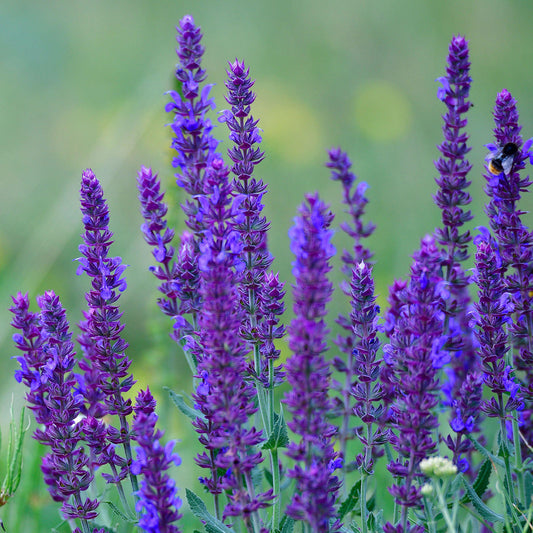
Anecdotal evidence shows that roses are less prone to disease and pests when they're planted with other herbaceous plants and shrubs. Salvias (sages) are one of the best plants to pair with roses, as their scent profile contains sulphur, which inhibits fungal growth, helping to prevent blackspot. (Don't worry, you can't smell the sulphur!) They also have a long flowering season and are a wonderful plant for pollinators.
Salvia's tall spires of flowers are a beautiful contrast to roses. The blue and violet varieties, such as Salvia 'Caradonna' and 'Bumbleblue' are my favourites, and look amazing with orange or yellow roses like Rosa 'Summer Beauty' and 'Precious Gold'. Salvias come in a wide range of colours, so it's easy to find the perfect match for your roses.
Dahlias and cosmos

Dahlias and cosmos are a classic cottage-garden pairing. Cosmos's feathery foliage gives an airy feel to the flower bed, softening the larger, more structured leaves of the dahlias. Dahlias come in all shapes, sizes and colours, making it easy to create a complementary or contrasting pairing.
To get a soft, romantic look, choose complementary flowers in shades of pink and purple, such as Dahlia 'Lavender Perfection', Dahlia 'Franz Kafka' and Cosmos 'Xenia'. For a colourful hot border, plant a cosmos mix of gold, orange, and red flowers with Dahlia 'Colour Spectacle' or Dahlia 'Sylvia'. Or go for dramatic contrast with Dahlia 'Black Touch' and Cosmos 'Lucinda'.
Cosmos and dahlias both love full sun and moist, free-draining soil. Plant them in a sheltered spot and tie the plants to stakes or another support structure to prevent the stems from snapping under the weight of the flowerheads.
French marigolds and tomatoes

French marigolds (Tagetes patula) are one of the best companion plants for tomatoes and a stalwart of any companion planting scheme. As well as attracting pollinators and suppressing parasitic nematodes, French marigolds release a chemical called limonene which has been proven to repel whiteflies. They add a cheerful colour to any garden and are one of the longest-flowering annuals – I've had them flowering through to November in mild years.
Marigolds and tomatoes are both easy to grow from seed, and you can plant them together in beds, grow bags or pots. If you want to start growing your own food, tomatoes are an ideal plant to try, as long as you have a sunny spot to grow them in. The hardest part is choosing which varieties to grow: for beginners, I recommend a bush variety of cherry tomatoes, such as 'Tumbling Tom Yellow' or 'Red Alert', as these are easy to grow in pots and don't require staking or pruning.
Lavender and rosemary

Lavender and rosemary are the couple who were always meant to be together. They agree on everything from soil conditions (well-drained and sandy) to sunlight (lots of it, please!). Both take pride in their appearance, offering complementary scents and evergreen foliage. Their flowering periods overlap – rosemary blooms slightly earlier – and between the two, you can have flowers throughout spring and summer.
Rosemary and lavender are a perfect combination for Mediterranean and drought-tolerant gardens, sensory beds and kitchen gardens. Lavender is a wonderful edging plant for paths and beds, whereas rosemary can be trimmed to form a neat mid-height hedge. Both plants are loved by bees, butterflies and ladybirds, and the herbs have culinary and medicinal uses.
English lavender and its hybrids are the most tolerant of our wet, cool winters and are the best option if you want to keep your plants outside all year round. Popular cultivars include Lavender 'Hidcote' and 'Munstead'. French and Spanish lavenders are more tender and may need to be brought indoors over winter, but offer a different look. Lavender stoechas is a particularly attractive half-hardy variety.
Rosemary plants can either be upright cultivars, such as Rosemary 'Miss Jessopp's Upright' and 'Tuscan Blue', or varieties of trailing rosemary, which look wonderful in pots or left to sprawl over walls and rockeries. All are hardy, but may need some protection during wet or very cold winters.
Heucheras and hardy geraniums

Heucheras and hardy geraniums (cranesbill) are perfect companions for a low-maintenance garden. Both are hardy, easy to grow and generally trouble-free. Heucheras are the backbone of the pairing, giving you year-round colour and interesting, ruffled foliage, along with spikes of tiny flowers in summer. Hardy geraniums bring the flower power to the partnership, with a long blooming season from late spring through to autumn.
Thanks to heuchera's vast range of foliage colours, this plant combination gives you plenty of options for different aesthetics. For an elegant, modern look, combine the white flowers of Geranium 'Album' with the deep purple-black leaves of Heuchera 'Black Pearl'. If you prefer a more vibrant colour scheme, plant Heuchera 'Lime Marmalade' alongside a blue geranium like Geranium 'Johnson's Blue' – this is also a good option for more shaded beds. Geranium 'Pink Pouffe' and Heuchera 'Wild Rose' are a more subtle combination, perfect for cottage garden beds.
Sweet peas and beans

Sweet pea pods are inedible, but plant sweet peas with climbing beans, such as French or runner beans, and you can grow flowers and food in the same spot – ideal to make the most of space in a small garden. Sweet pea flowers are a magnet for bees and other pollinators, which will pollinate your beans, giving you a bumper harvest!
Sweet peas and beans are both climbing plants, though they climb in different ways. French beans and runner beans are happy winding their way up bamboo canes, but peas need a finer support for their tendrils to grip onto. When combining the two, plant your beans at the foot of the canes or sticks used to create your wigwam support and the sweet peas in between. You can use pea netting or wind string round your sweet pea seedlings and tie it to the top of the frame to give them something to scramble up. Both beans and sweet peas are hungry plants, so don't forget to feed them regularly!
Hostas and astrantia

If you have a shaded garden or bed, likelihood is you have at least one hosta – and have experienced the frustration of losing it to the slugs. As the RHS and celebrity gardeners emphasise, slugs and snails do have their place in the garden, but that place is not on my hostas! Astrantia (masterwort) is a slug resistant plant, so pairing these two shade-tolerant perennials may help deter the hosta-chomping gastropods.
Astrantia's flowers, which comprise a star-like array of petals around a pincushion centre, rise above the broad leaves of the hosta on fine stalks. Pink varieties like Astrantia 'Roma' and 'Star of Beauty' give a pop of colour against the cream-and-green leaves of Hosta 'Patriot'. For a more muted combination, pair the blue-grey Hosta 'Halcyon' with the papery white flowers of Astrantia 'Shaggy'.
Achillea and kniphofia

You have plenty of options when it comes to choosing flowers for a hot border, but achillea and kniphofia is one of my favourite combinations and proof that when it comes to plant couples, opposites attract. The brightly coloured spines of flowers that give kniphofia its common name of red hot poker are a wonderful contrast to achillea's flat-topped clusters of delicate flowers. Achilleas also give kniphofias a helping hand when it comes to aphids, as they're highly attractive to predatory insects.
Kniphofias range in shades from bright red (Kniphofia 'Poco Red') through to tangerine orange (Kniphofia 'Poco Sunset') and bright yellow (Kniphofia 'Poco Citron'). Achilleas are much more varied, but for a hot flowerbed, opt for a similar colour palette, with cultivars like Achillea 'Terracotta' and Achillea 'Sunny Seduction'.