Salvias offer vibrant colour throughout the summer and early autumn months. Their flowers are a magnet for pollinators and a wonderful addition to cottage gardens, contemporary garden borders and wildlife-friendly planting schemes. Salvias grow well in pots or in beds, and many varieties thrive in tricky dry environments.
Salvias are popular garden plants that are generally low-maintenance and drought-tolerant. As there are so many types of salvia, you can find one to suit almost any colour scheme and garden design.
All salvias are safe to eat, but most ornamental varieties aren't considered edible. Grow culinary sages if you want to use them in the kitchen and leave the flowering sages for the bees to enjoy. As well as common sage, rosemary plants are now classified as salvias, and chia seeds come from the South American species Salvia hispanica. Perovskia (Russian sage) also used to be a separate genus of plants, but is now considered to be part of the Salvia genus.
Types of salvias
Salvia is a huge genus that includes shrubs, hardy perennials and tender plants. There are five main types of salvia:
Culinary salvias: Grown primarily for culinary uses, this category includes Salvia officinalis (common sage) and Salvia rosmarinus (rosemary).
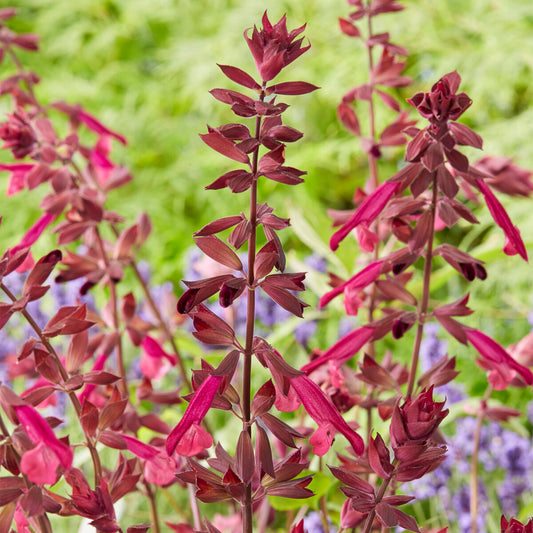
Annual bedding salvias: Tender species, such as Salvia splendens, which are grown as colourful bedding plants and discarded once they finish flowering. E.g., Salvia 'Vista Red'.
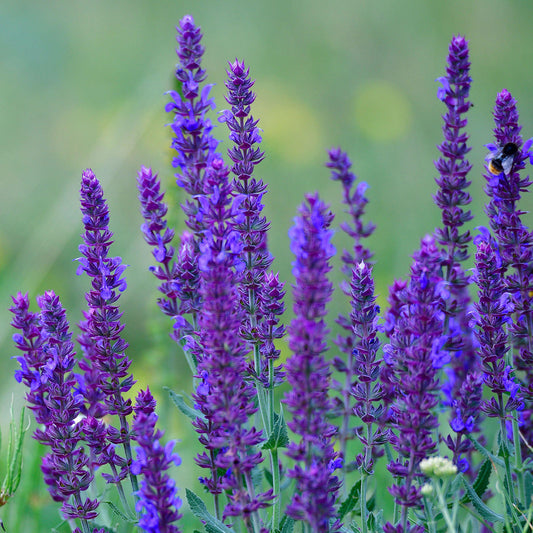
Hardy perennial salvias: Herbaceous salvias that die back to the ground over winter and reemerge in spring. This category includes many popular border salvias, such as Salvia nemorosa and Salvia x sylvestris. E.g., Salvia 'Caradonna', Salvia 'Ostfriesland'.
Tender or half-hardy perennial salvias: Herbaceous salvias that can grow back year after year, but may need moving into a greenhouse or additional protection over winter. Includes cultivars of Salvia greggii and Salvia elegans. E.g., Salvia 'Ember's Wish', Salvia 'Amistad'.
Shrubby salvias: Species with woody stems that don't die back over winter, including Salvia microphylla and Salvia x jamensis. Shrubby salvias are technically sub-shrubs and usually hardy, but some require winter protection in cold areas. E.g., Salvia 'Cherry Lips', Salvia 'Royal Bumble'.
Where to plant salvias

Salvias prefer full sun and well-drained soil. They thrive in dry conditions and are an excellent plant for gravel, Mediterranean and climate-resilient gardens, as well as south-facing cottage garden beds. Tender salvias prefer slightly moister, more fertile soil. Salvias don't like wet feet (with the exception of Salvia uliginosa), so avoid planting them in areas prone to waterlogging.
Most salvias grow well in pots. Check the mature size of the variety you're looking at, as some can grow up to a few metres tall. Growing tender and half-hardy salvias in pots is a good option if you have a frost-free place to store them over the winter. If you don't, then it may be safer to grow the plants in the ground and cover them with a thick layer of mulch in winter.
Tall salvias (e.g., Salvia 'Armistad') look great at the back of a border, but most border salvias work best in the middle or at the front of beds. They are a natural companion plant for roses, as their scent helps reduce fungal diseases, such as black spot, and pair well with feathery ornamental grasses and sun-loving perennials like echinacea, achillea and eryngium.
When to plant salvias
Hardy salvias, like Salvia nemorosa, are best planted in spring, though you can also plant them in early autumn if the ground isn't too wet. Plant tender salvias in May or June, once the soil has warmed up and all risk of frost has passed.
How to plant salvias

Depending on your soil, you may need to do some preparation before planting salvias. If you have clay soil, dig in plenty of organic matter to help improve drainage. You may also need to add compost or other organic matter to dry soils if you want to plant tender salvias.
Once you've prepared your soil, dig a hole a little larger than the pot your plant came in. Add some grit to the bottom of the hole if needed (e.g., on heavy soils). Place your salvia plant in the hole and fill the space around it so the soil is at the same level as in the pot. Firm the soil gently and water it well.
When planting salvias in pots, use a peat free compost with added John Innes, and mix in some sand or grit to help with drainage. For bedding plants, you can use a standard multipurpose compost.
Caring for salvias
Salvias are drought tolerant, but as with any new perennial, young plants need watering during dry spells for the first spring and summer. Plants in containers, particularly tender salvias, need more regular watering, as the foliage often prevents rain from soaking the compost. Feed salvias in pots monthly during the growing season with a liquid high-potassium feed, but avoid feeding plants grown in beds and borders.
Common sage (Salvia officinalis) and hardy perennials, such as Salvia nemorosa, Salvia × sylvestris and Salvia pratensis, are fully hardy in all parts of the UK. In colder areas, leave the foliage on the plant over winter to protect the plant from hard frosts.
If you have very mild winters or a warm microclimate in your garden, then you may be able to overwinter half-hardy salvias, such as Salvia 'Armistad' outdoors. Add a layer of thick, dry mulch (e.g., garden compost or straw) to help protect the plant. Otherwise, it's best to lift tender salvias and plant them in containers which you can move to a frost-free greenhouse or other location for the winter.
If you don't have a suitable location for tender plants or you're short on space, another option is to take cuttings from tender salvias and overwinter them indoors before planting out in late spring.
Pruning salvias

How and when you prune your salvia depends on the variety. Cutting back salvias is best done in mid-spring, as the weather is starting to warm up. Once new shoots emerge on herbaceous plants, you can cut the old foliage down to near the ground. You can also cut back woody and semi-evergreen salvias near the base to renovate plants that have become a little bare. If they don't need a full renovation, remove any dead or damaged stems on shrubby salvias and cut back the others by a third to a half to retain the shape.
You can encourage a second flush of flowers from border salvias like Salvia nemorosa by cutting back the foliage and flowers to just above ground level in July, as the flowers are beginning to fade. In milder parts of the UK, you can cut them back again in autumn to neaten up your beds; otherwise, leave the foliage on and prune them in spring.
How to propagate salvia
Salvias are easy to propagate, and you have various options, including growing from seed, taking cuttings and layering.
You can take salvia cuttings from perennial plants in late spring to early summer (softwood cuttings) or late summer to autumn (semi-ripe cuttings). Once your cuttings have developed roots, pot them up into individual pots. You can plant hardy salvias grown from softwood cuttings out in your garden in early autumn, but you'll need to overwinter tender salvias under cover and plant them out the following spring.
If you have large clumps of hardy perennial salvia, such as Salvia nemorosa, you can lift and divide plants in spring, then replant the divisions. As well as giving you new plants, this helps extend the life of border salvias.
Annual and biennial salvias are easy to grow from seed. Sow annuals under cover in March or April to plant out at the end of May or the beginning of June. Biennial salvias flower the year after they're sown. Sow seeds in June or July and overwinter the seedlings in a greenhouse or cold frame before planting out in spring.
You can propagate shrubby salvias and Salvia officinalis by layering. This is quick and easy, but it can take a couple of years to root.
Common problems
The main challenge when growing salvias is helping them survive the winter months. Otherwise, they're pretty resilient plants. Deer and rabbits avoid them, and though slugs may nibble on young plants, once they've grown a bit, they tend to go for more palatable offerings.
Salvias may get attacked by insects such as aphids, capsid bugs and leafhoppers. If you're growing salvias in pots, then vine weevils are also a possibility.
Too little or too much water can cause plants to droop. Make sure you let the soil dry out sufficiently in between watering to prevent root rot.
Our favourite salvia cultivars
Salvia 'Caradonna' is a very popular hardy perennial salvia with deep purple, upright stems packed with violet flowers that look particularly stunning paired with apricot roses or foxgloves. The foliage forms a neat mound, and if you cut it right back after the first flowering, it will produce fresh foliage and a second flush of flowers.
Salvia 'Amistad' is a striking, tender salvia that can grow up to two metres tall. Its velvety purple flowers bloom on deep purple-black stems from midsummer through to October or November.
Salvia 'Love and Wishes' produces deep magenta flowers above light great foliage. The elegant flowers can be a subtle backdrop for bright, jewel-toned flowers or a bold accompaniment to neutral grasses.
Salvia 'Cherry Lips' has vibrant pink and white bicolour flowers with an unusual shape that reminds me of fizzy cherry sweets. It's very similar to the popular Salvia 'Hot Lips', but the flowers have a deeper cherry-red tone.
FAQ
What is salvia?
Salvia is a large genus of plants with the common name of sage. Culinary varieties are a staple of herb and kitchen gardens, while ornamental salvias are loved for their long blooming season and colourful, pollinator-friendly flowers. The term "salvia" is also sometimes used as a shortened form of Salvia divinorum, which is a hallucinogenic herb native to Mexico.
Are salvias perennials?
Some salvias are perennials, including most popular border salvias like Salvia nemorosa 'Caradonna', Salvia 'Amistad' and Salvia 'Royal Bumble'. The Salvia genus is large and also includes annual and biennial species that are often used as bedding plants.
When do you prune salvias?
The best time to prune salvias is in spring once you see new shoots emerge. In mild parts of the UK, you can cut back hardy salvias in autumn, but leaving the foliage on the plant over winter helps protect it from harsh frosts. Cultivars of Salvia nemorosa, such as Salvia 'Caradonna', Salvia 'East Friesland' and Salvia 'Pink Inspiration', also respond well to a mid-season chop in July, which encourages fresh foliage and flowers in late summer.