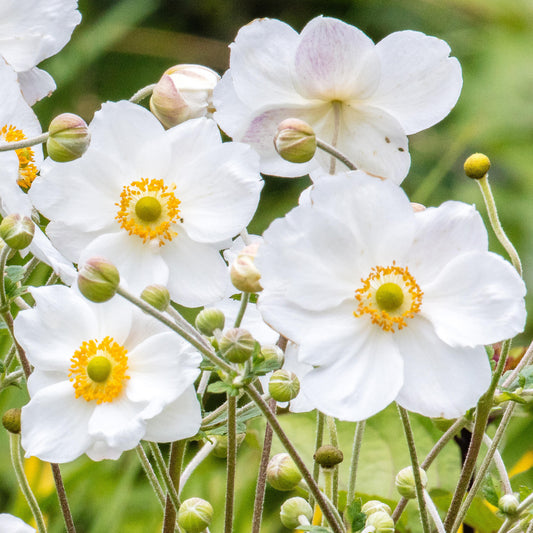
Japanese anemones are a welcome sight on autumn days, when winter feels just around the corner. The pretty white or pink flowers light up shady parts of the garden, adding colour and interest as other flowering perennials fade.
Japanese anemone (windflower) is the common name for Anemone x hybrida and Anemone hupehensis plants. Not to be confused with the spring-flowering anemone bulbs, these herbaceous perennials are at their best in late summer and early autumn, with the exception of the unusual, petite Anemone 'Wild Swan', a hybrid that blooms intermittently from May to November.
Japanese anemone flowers are saucer shaped and float on top of strong, wiry stems. They sway beautifully in a strong breeze, earning their alternative name of windflower. Some varieties have a single ring of petals, while others have several layers and form ruffled blooms. They sometimes take a year or two to settle in, but once established flower freely and often spread to fill any available space.
Where to plant Japanese anemones

Japanese anemones are ideal for lightly shaded borders and grow well under tall trees and on woodland edges. You can also grow them in partial or full sun as long as the soil is moist. Most varieties grow to around a metre (when in flower), but some Anemone x hybrida cultivars are taller and best suited to a back-of-border spot.
Japanese anemones need fertile, moist soil. They will struggle in very dry conditions and do not like to be waterlogged. Once established, they are moderately drought tolerant when planted in shade.
You can grow Japanese anemones in pots, as long as you choose a compact cultivar and keep the container well watered. Anemone 'Frilly Knickers', Anemone 'Wild Swan' and the Fantasy series, which includes Anemone 'Fantasy Red Riding Hood' and Anemone 'Fantasy Ariel', are good choices for patio gardens.
Most Japanese anemones form clumps that spread via underground rhizomes. Consider this part of their nature and take it into account before chucking them into a mixed bed with less vigorous plants. You can let them spread naturally (they look wonderful planted en masse) or plant them alongside a path or other element of hard landscaping that will help contain the roots.
When to plant Japanese anemones
Plant Japanese anemones in spring or autumn, when the soil is moist and warm. You can plant them at other times of the year but avoid planting when it's very hot and dry, or when the ground is frozen.
How to plant Japanese anemones
Japanese anemones like rich, fertile soil, so you may want to dig some compost or other organic matter into the ground before planting. Dig a hole twice the width of the pot your plant came in and the same depth. Remove your Japanese anemone plant from its pot and place it in the hole. Fill around it with soil and gently firm down the soil around the plant. Water it well.
When planting Japanese anemones in pots, choose a container at least 30 cm in diameter with drainage holes. You can use a multi-purpose peat-free compost and mix in some well-rotted manure or garden compost for extra nutrients, or add grit to help with drainage. Plant your Japanese anemone at the same depth it was in its growing pot.
Japanese anemone care

To help your new plant establish, water it regularly for the first growing season. Bear in mind that plants under tree canopies may not get that much water during light showers, so you may need to water your windflowers even if it rains. Once Japanese anemones establish, they're more resilient, but you may still need to water them during droughts.
You don't need to feed plants grown in borders, but adding a thick layer of mulch in spring will add nutrients to the soil and help keep it moist.
You'll need to pay more attention to Japanese anemones in containers and water them regularly so the compost doesn't dry out. You can either apply a slow-release fertiliser in spring or use a liquid fertiliser during the growing season.
Japanese anemones are fully hardy and don't require winter protection. You may wish to wrap pots in hessian or bubble wrap to protect them during very cold periods.
You can divide mature plants every three or four years. This helps prevent clumps from getting too big.
When to cut back Japanese anemones
The best time to cut back Japanese anemone plants is in early spring before new growth emerges. Cut the stalks at the base of the plant and remove any dead leaves or stems. This approach allows insects to shelter in the dying foliage over winter, but if you prefer a neater look to your flower beds, you can cut back the foliage at the end of autumn or the beginning of winter.
Japanese anemone propagation
Propagating Japanese anemones is best done by dividing mature plants in spring or autumn. Dig up the entire rootball and use a sharp knife or spade to divide it into sections. Replant each section in your garden immediately or give one to a friend if you've run out of space! Japanese anemones don't love having their roots disturbed, so the divided plants may refuse to flower for a year or two.
If you don't want to dig up a clump, you can also propagate Japanese anemones by taking root cuttings in autumn or winter. Simply dig the soil out from one side of your plant until you find the fleshy parts of the roots. Cut off pencil-thick sections up to 12 cm in length and lay them horizontally on top of some damp potting compost. Cover with a thin layer of compost and place in a sunny spot.
Hybrid plants (i.e. most cultivars sold in the UK) rarely produce seed, and Japanese anemone plants grown from seed take several years to flower.
Japanese anemones: problems
Japanese anemones are resistant to common garden pests such as slugs and rabbits. They can be prone to powdery mildew in very dry conditions; you can help prevent this by keeping plants well watered and dividing old clumps so they don't become congested.
Although they can cope with dry conditions once established, Japanese anemones prefer moist soil. If you notice the leaves turning yellow or brown, this is most likely due to dry soil. Give your plant a good drink and add some mulch to help lock the moisture into the soil.
Eelworms can cause damage to leaves, though are unlikely to be a problem unless there's a very large population. You can remove and destroy affected leaves.
Our favourite varieties of Japanese anemone
Anemone 'Honorine Jobert' is a very popular, tall cultivar due to its simple, pure white flowers that bounce light around shady gardens. Plant it at the back of a large border or under deciduous trees.
Anemone 'Frilly Knickers' has beautiful semi-double blooms with ruffled pale pink and white petals. It grows to around 60 cm and is a good choice for growing in containers or smaller gardens.
Anemone 'Queen Charlotte', also known as 'Königin Charlotte', is another good back-of-border variety with large, rose-pink flowers carried on tall stems.
Anemone 'Fantasy Ariel' is a compact variety with deep magenta petals that contrast dramatically with the vibrant yellow stamen. A colourful choice for pots.
FAQ
Can Japanese anemones grow in shade?
Japanese anemones thrive in light, dappled or partial shade. They are a brilliant choice for brightening up a shady border in the latter part of the growing season. You can try growing Japanese anemones in deep shade, but you may find the plant gets leggy and doesn't produce as many flowers.
When do Japanese anemones bloom?
Japanese anemones flower in late summer and early autumn, usually from August to October. Many will continue flowering through to November in mild years. Anemone ‘Wild Swan’ and Anemone 'Praecox' bloom earlier than other varieties.
Are Japanese anemones invasive?
While not as invasive as many plants, Japanese anemones do have a tendency to spread via underground rhizomes when grown in ideal conditions. This isn't usually a problem as long as they're planted in an appropriate spot and you keep an eye on them. Compact, clump forming cultivars, such as Anemone 'Frilly Knickers' and Anemone 'Wild Swan', are less invasive than larger varieties. To prevent your Japanese anemone from working its way around your garden, plant it in a bed contained by hard landscaping and pull up any new shoots you see in the spring.