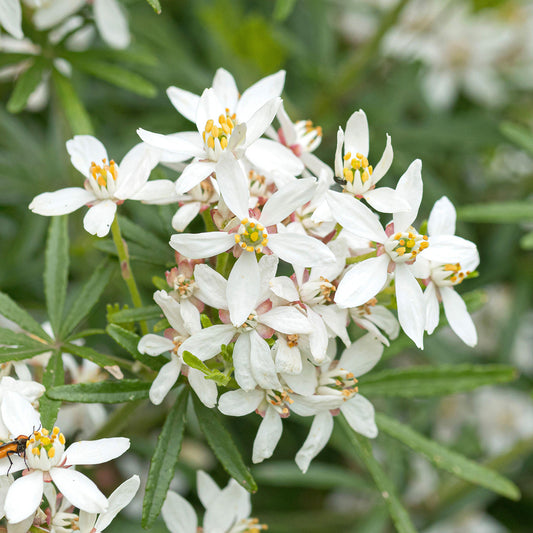
Choisya (Mexican orange blossom) is a fragrant, mid-sized shrub with dark green or golden leaves that add year-round colour to your garden. Plant it close to a seating area or pathway to enjoy its perfumed scent on warm summer evenings.
Choisyas are a group of mid-sized evergreen shrubs that bloom in late spring, with some varieties producing a second flush of flowers in autumn. The plant’s common name, Mexican orange blossom, comes from its aromatic leaves and clusters of white, citrus-scented flowers. Smaller varieties grow up to a metre tall and wide, with larger varieties growing up to 2.5 metres. As long as choisyas are given the right conditions to thrive, they’re easy to grow with little maintenance required.
Where to plant choisya

Most choisya perform best in full sun or light shade. The exception is yellow-leaved varieties, such as Choisya ‘Sundance’, whose leaves are easily bleached by the sun. Choisya are hardy down to −10°C, but they suffer in icy winds, so choose a sheltered spot, particularly if you live in a colder part of the country.
Choisyas like fertile, well-drained soil, so avoid planting a choisya bush in heavy clay or waterlogged ground. You can grow choisya as a feature shrub, as part of a mixed border or a beautiful flowering hedge. Smaller varieties of choisya, such as ‘White Dazzler’ and ‘Goldfingers’, will happily grow in a large pot.
When to plant choisya
Choisyas are best planted in spring, so they have the full summer to settle in before cold weather arrives. This is more important in cold parts of the country. You can plant container-grown choisyas at other times of the year, but they may need a bit more care and take longer to become established.
How to plant choisya
Mix some compost or other organic matter into the soil before planting. Dig a hole the same depth as the roots but twice as wide. Place your choisya in the hole and backfill – the soil should come to the same level as when it was in the pot (just at the top of the roots). Firm the soil gently with your foot and water well. To help the shrub establish strong roots, water it thoroughly every couple of days during dry spells for the first growing season.
When planting choisya in pots, you have two options. The best option is to plant it in a container a little bigger than the one it came in and replant it in a larger pot each spring. You can also plant it directly into a large container, but make sure the pot has good drainage and add some grit to the compost, so it doesn’t get waterlogged.
How to care for choisya

Once established, choisya are easy to care for. Add a thick layer of well-rotted compost, manure or leaf mould around the shrub in spring and water occasionally during prolonged dry spells. This should be enough for most plants, but if the soil is particularly poor, you can also add a general fertiliser in spring.
Choisyas grown in pots need a little more attention. Replace the top couple of inches of compost in early spring and mix in a slow-release fertilizer. You can also give it a monthly liquid feed during the growing season.
Choisyas grown in north-facing or exposed locations and shrubs in containers may need some protection during cold winters. It’s best to move pots to a porch or sheltered spot against a wall. You can also wrap pots and vulnerable plants in fleece when cold temperatures are forecast.
How to prune choisya
Most choisya don’t require regular pruning, other than removing dead or damaged stems. However, if you want to trim overlong branches or reshape a choisya bush, it can take a hard pruning without suffering as long as you time it right.
Pruning a choisya is best done in mid-spring, after the risk of frosts has passed, but before flowering. If your choisya flowers early or you have late frosts, you can also prune after flowering has finished. A choisya hedge is best trimmed after flowering.
How to propagate choisya
You can take semi-ripe choisya cuttings in mid to late summer. Select young, non-flowering shoots that are firm at the base. Trim cuttings to just below a node and remove leaves, leaving just 2–4 per cutting. Insert cuttings into a pot of cutting compost and water. Either place pots in a heated propagator or cover each pot with a plastic bag and place it on a windowsill. Once roots appear at the bottom of the pot, you can repot the new plants into separate small pots to grow on and plant out the following year.
Common choisya problems
Choisyas rarely get attacked by pests and are generally trouble-free. The biggest risk is frost damage, but plants should recover from this in the spring. You can prevent this by protecting vulnerable plants with fleece during cold snaps. Snails can sometimes cause problems for younger plants. If you’re concerned, get out a torch and go on a snail hunt!
Our favourite choisya varieties
Choisya ternata is the “original” and most popular choisya. You can grow it as an individual shrub, but its dense foliage also makes it a good choice for hedging. It often flowers twice and can bloom sporadically into winter.
Choisya ‘White Dazzler’ is a compact variety with slim, dark green leaves that grows well in containers or as a low hedge.
Choisya ‘Sundance’ is a cultivar of Choisya ternata with striking yellow-green leaves. The leaves may lose some of their golden colour in the sun, so this variety is best planted in light shade.
Choisya ‘Aztec Pearl’ has slender, dark green leaves and pale pink buds that blossom into white flowers. It’s more compact than Choisya ternata, making it a good choice for mid-sized borders.
FAQ
When is the best time to plant choisyas?
It’s best to plant choisyas in spring, so they have a full growing season to get established. Choisya can also be planted in early autumn or summer, though plants may need extra watering during dry periods.
When should you prune choisya?
Most choisya don’t need pruning unless you want to reduce the size of a bush or reshape it. In this case, you can prune in mid-spring or immediately after flowering (for early-flowering varieties).
When do choisya flower?
Choisya plants flower in late spring and early summer, from April to June or the beginning of July. Some varieties, including Choisya ternata, may flower for a second time in autumn.
Is choisya evergreen
Yes, choisya is an evergreen shrub. This makes it ideal for adding year-round colour to your garden. Most choisya have dark green leaves, though some varieties, such as the popular ‘Sundance’, have pale, yellow-green leaves. Both the leaves and flowers are scented.
Is choisya poisonous to dogs?
There have been no toxic effects reported from dogs eating choisya, so it’s considered a safe plant to include in a dog-friendly garden.