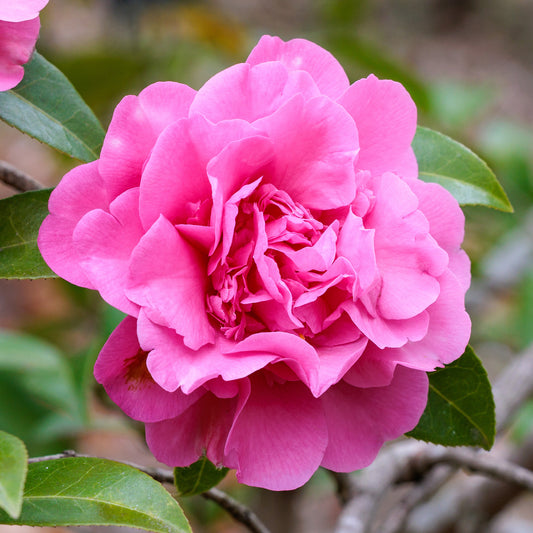
Camellias defy the bleak winter months, producing masses of showy, rose-like blooms from late winter through spring. These evergreen shrubs provide a striking focal point for shady borders, patios and courtyard gardens.
Camellias are one of many plants that divide gardeners. Some regard them as divas of the garden, due to their refusal to flower profusely if their specific requirements are not met. This is hardly the fault of the camellia, which is simply seeking a home similar to its native East Asian climate and soil – conditions which are rarely found in UK gardens. Fortunately, they are happy growing in pots and, if planted correctly, produce a grand display of showy flowers at a time when most gardens need a boost of colour.
The most popular types of camellias in UK gardens are cultivars of Camellia japonica (Japanese camellia), Camellia × williamsii and Camellia sasanqua. Camellia sinensis (tea plant) is grown commercially for tea. You can also grow it at home, though it's a lot of effort to go to for a few cups of tea a year.
Camellia sasanqua plants flower in late autumn and early winter, with most other varieties flowering from late winter or early spring. Japanese camellias are some of the most popular, but Camellia × williamsii hybrids are also worth considering, particularly if you live in colder parts of the UK, as they tend to be hardier.
Where to plant camellias

The ideal environment for camellias is a sheltered area with dappled sun. Woodland areas are ideal, being similar to their native habitat. Overnight frosts followed by direct morning sun can damage delicate flowers, so it may be best to avoid east-facing spots. Different species vary in their tolerance of sun, so you can find a variety to suit most gardens.
Camellia x williamsii hybrids (e.g., Camellia 'Debbie', Camellia 'Ruby Wedding') are the most shade tolerant and best choice for north-facing gardens or areas which receive little direct sunlight. Camellia japonica cultivars (e.g., Camellia 'Bonomiana', Camellia 'Blood of China') need some direct sun to flower well, but thrive in partial shade. Camellia sasanqua will grow well in full sun as long as it's well watered.
Camellias require acidic soil to thrive, similar to rhododendrons and azaleas. Many varieties grow well in pots, which is your best option if the soil in your garden is alkaline. You can use a cheap testing kit to find out the pH of your soil if you're not sure. The soil or compost should be moist but well-drained.
Some camellias can grow into large shrubs, so make sure you have sufficient space if you choose a more vigorous variety, such as Camellia 'Princess Baciocchi'.
When to plant camellias
The best time to plant camellias is in early-mid autumn, when the soil is moist and warm. This gives the plant time to settle in and spread its roots before winter. If you're planting a camellia in spring or summer, be sure to water it well.
How to plant camellias
Soak the roots of your camellia shrub well before planting. Dig a hole twice the width of the camellia's rootball and position the plant in the hole. Planting a camellia too deep can cause problems, so make sure the top of the rootball is at or just above the surface. Backfill the hole, firm the soil and water the plant well. Make sure you allow plenty of space between plants when planting camellias in groups.
When planting a camellia in a container, you need to use an ericaceous compost and choose a pot with good drainage. Most camellias are slow growing, but select a pot that's large enough for the plant to spread out its roots. When a camellia begins to outgrow its pot, it's best to repot the plant in spring.
Caring for a camellia

Like all newly planted shrubs, camellias need regular watering during the first few summers. The flower buds for the following year develop during late summer, so it's especially important to keep the soil moist during this time. Rainwater is best, as it's naturally slightly acidic, though it's better to use tap water than not water at all.
Camellias grown in the ground don't usually require feeding, though if a plant looks like it's struggling, you can feed it with an ericaceous fertiliser in spring or early summer. Avoid feeding it in late summer or autumn, as this can cause buds to drop. Applying a thick layer of mulch in spring helps improve the soil and keep it moist.
Japanese and common camellias are hardy across most parts of the UK, but you may want to take steps to protect them in extreme winter conditions. Camellia sasanqua plants will require some winter protection in many parts of the UK. Wrap outdoor plants in fleece or move container-grown shrubs into a greenhouse.
When to prune a camellia
Deadheading camellias is optional and mainly done to improve the look of the plant rather than to encourage flowering. The main reasons to prune your camellia are to maintain its shape or control its size, particularly if you're growing it in a container. The best time to prune a camellia is after the plant has finished flowering, usually in late spring. The flower buds for the following year develop in late summer, so avoid pruning at this time.
You can hard prune overgrown camellias to renovate them, though this is best done over a few years. Carry out hard pruning in March and cut back up to half of the growth in the first year, then further prune and thin it out the following year. Camellias usually respond well to hard pruning, but it will affect flowering for the first year or two afterwards.
How to propagate camellias
Camellia propagation by seed is slow and unreliable, and the resulting plants will likely differ from the parent plant. Propagating camellias by taking cuttings or layering is more straightforward. You can also use grafting, but this is more complicated and requires more skill and experience.
Layering is best carried out in spring on plants with flexible shoots that you can bend down to the ground. Cut along the stem for up to 5 cm, 30 cm back from the tip of the shoot, making sure the incision runs through a leaf bud, and apply hormone rooting powder. Dig a narrow trench leading out from the parent plant and peg the stem into the trench with the shoot tip pointing upwards out of the soil. Fill in the trench and water if needed. Once the new plant has developed a good root system (this takes about a year), you can transplant it to a new location.
How to take cuttings from a camellia
You can take semi-ripe cuttings from camellias in mid to late summer. Use sharp secateurs to cut off a shoot just above a leaf bud, where flexible new growth meets older wood. Trim your cutting so it has just one leaf and cut a short strip of bark off at the base to help it root. Insert the cuttings into a gritty potting compost and leave them for several months to root.
If you don't get around to taking cuttings in the summer, you can also propagate camellias from hardwood cuttings taken in winter.
Common problems
Although camellias are quite easy to grow in ideal conditions, things can quickly go wrong if you plant them in the wrong place. You also need to keep an eye on them throughout the year – it's not a plant-it-and-forget-about-it shrub. Here are some of the main camellia problems you may encounter:
-
If you notice yellow leaves on camellia plants, this is most likely to indicate iron deficiency as a result of being planted in alkaline soil. Repot container plants in fresh ericaceous compost. You can treat plants in the ground with a chelated iron supplement, but if your soil is alkaline, the problem is likely to reoccur, and you may be better off cutting your losses and growing camellias in containers.
-
Camellias not flowering is usually due to a lack of attention the previous summer. If you forget to water your camellia during dry spells when the buds are forming, they may fail to form. Make sure the soil around your camellia doesn't dry out.
-
Too much water can also cause problems. Camellias are susceptible to root decay if the soil gets waterlogged, as well as Phytophthora root rot and honey fungus. This can be fatal for the plant, and the best way to prevent these problems is to make sure the soil is well drained, particularly for plants growing in pots.
-
If you see camellia leaves turning brown, this could be a result of environmental conditions (e.g., high temperatures, frost or wind damage), or a problem with the roots. Brown blotches on leaves may be a sign of leaf blight.
-
Frost damage is a common cause of brown flower buds. This often happens when plants receive early morning sun after a frosty night. If your camellia is in a pot, try moving it to a different location or cover the plant with fleece on cold nights.
-
Camellia flower blight is a fungal disease that affects camellia flowers. It causes brown flecks and blotches on the petals, and infected flowers often fall off early. There's no easy cure other than disposing of affected flowers as quickly as possible.
-
Camellia gall causes odd-shaped cream-coloured swellings to form on a plant during summer. Remove galls as soon as you spot them to prevent the infection from spreading.
Our favourite camellia varieties
Camellia 'Debbie' is a popular Camellia x williamsii hybrid that produces vibrant pink peony-like blooms from March to May. It's more resistant to the cold than other camellias, making it a good choice for more northerly gardens.
Camellia 'Lady Campbell' is an early-flowering spring camellia with intricate, deep-red flowers that can appear as early as January and continue through March. It grows well in pots as well as in borders.
Camellia 'Silver Anniversary' is an RHS Award winning white camellia that blooms from late winter to early spring. Brilliant white, layered petals surround golden-orange stamens.
Camellia 'Spring Festival' is a lovely pink camellia that produces masses of small flowers throughout early spring. It can reach an eventual height of 4 m, but its upright form means it can be trained up a fence, pruned into a tree form or used as an informal camellia hedge.
FAQ
When do camellias flower?
Camellias flower in late autumn or early spring, depending on the variety. Camellia sasanqua flowers in late autumn, from around October to December or January. Camellia japonica cultivars flower in early spring, with most beginning to bloom in February or March.
When is the best time to plant camellias in the UK?
October is the best time to plant camellias in the UK. The soil is warm and moist enough to support strong root development before winter. If you plant camellias earlier than this, make sure you water them sufficiently to prevent the soil from drying out.
When should you prune camellias?
The best time to prune camellias is immediately after they've finished flowering. This will be early spring for Camellia sasanqua and late spring or early summer for Camellia japonica, Camellia x williamsii hybrids and other spring-flowering varieties.
Are camellias evergreen?
Yes, camellias are evergreen shrubs that hold their leaves all year round.
Do camellias need ericaceous soil?
Camellias prefer acidic soil, though some can tolerate neutral soil. They are unlikely to grow well in alkaline soils. If you don't have the right soil type, you can grow camellias in a pot filled with ericaceous compost.
Can camellias grow in full shade?
Most camellias prefer dappled or partial shade rather than full shade. If you want to plant a camellia in a shady area, try a Camellia x williamsii hybrid such as Camellia 'Debbie', 'Donation' or 'Ruby Wedding'.